T-Shirt Printing
Quick answer
Compare sublimation, heat transfer, DTF, embroidery and Hi-build with RIZER product examples. Learn how each works, which fabric suits it, and what to approve.
T-Shirt Printing in Sri Lanka: Methods, Product Examples and How to Choose
*By RIZER · Published and updated 23 October 2026*
**Short answer:** T-shirt printing is the process of adding a logo, text or artwork to a garment. The right method depends on the artwork, fabric, garment colour, placement and intended use. RIZER product records include sublimation, heat transfer, DTF, embroidery and Hi-build. The examples below show how those methods appear in selected catalog and project images; confirm the product specification and approve a mock-up before ordering.
**Key takeaway:** Sublimation is the best starting point for large, colourful artwork on polyester. Heat transfer and DTF suit many placed graphics, names and logos. Embroidery adds stitched thread branding, while Hi-build creates a raised effect. Not every method works on every fabric or design.
**Who this guide is for:** Sri Lankan businesses choosing staff branding, schools and universities planning batch shirts, sports clubs, event organisers, and apparel brands comparing print and logo finishes before requesting a quote.
> **Need help choosing?** [Send RIZER your artwork on WhatsApp →](https://wa.me/94777880200?text=Hi%20RIZER%2C%20please%20recommend%20a%20printing%20or%20logo%20method.%20Product%3A%20__%20Fabric%3A%20__%20Quantity%3A%20__%20I%20will%20send%20my%20artwork.)
What printing and decoration methods are shown in RIZER product records?
**Short answer:** Selected RIZER product records name five methods: sublimation, heat transfer, DTF, embroidery and Hi-build. The record is the source for which method is listed for a product; a photograph by itself cannot confirm how its decoration was made.
| Method listed | In simple terms | Examples in this guide | |---|---|---| | Sublimation | Dye is transferred into suitable polyester fabric using heat | Nilwala College, Wycherley band, TBS International and WISG | | Heat transfer | A printed design is attached to the garment using heat and pressure | Coast to Coast, Raid Amazones, Codimite and RIZER crew neck | | DTF | Direct-to-film: a design is printed onto transfer film and then heat-applied to fabric | Custom T-shirt (P1) | | Embroidery | Thread is stitched into the fabric to make a logo or design | W.A. Auto Supply and Coca-Cola polos | | Hi-build | A raised, dimensional logo finish | HNB polo and Women Crew Neck (P50) |
Heat transfer is a broad description of applying a printed design with heat; DTF is one specific transfer workflow. Embroidery is not printing, but it is included because product records list it as a way to decorate T-shirts and polos. The exact materials, process and available options can vary, so check the selected product's [specifications](/product/P40/rizer-corporate-polo-t-shirt/specifications) and [customization details](/product/P40/rizer-corporate-polo-t-shirt/customization).
How does sublimation printing work, and when should you choose it?
**Short answer:** Sublimation transfers dye into polyester fibres using heat. It is used for multicolour artwork, gradients and broad coverage on polyester garments. Choose it when you want a coordinated design across much of a shirt, rather than only a small logo.
In a typical dye-sublimation workflow, artwork is printed onto transfer paper and heat-pressed against compatible polyester fabric. Heat turns the dye into a gas that bonds with the polyester fibres. This is why fibre content matters: standard sublimation is not a suitable choice for a 100% cotton shirt. Many sublimation workflows also start from white or light fabric because the process does not print an opaque white layer over a dark garment. Confirm the base colour, material and production method with RIZER before finalising a design. See [Custom Ink's sublimation printing overview](https://www.customink.com/blog/what-is-sublimation-printing-for-activewear/) for more background on the process and polyester requirements.
These four product records list **Sublimation** as the logo/decoration method. Their images are grouped here so you can compare different garment shapes and artwork styles side by side.
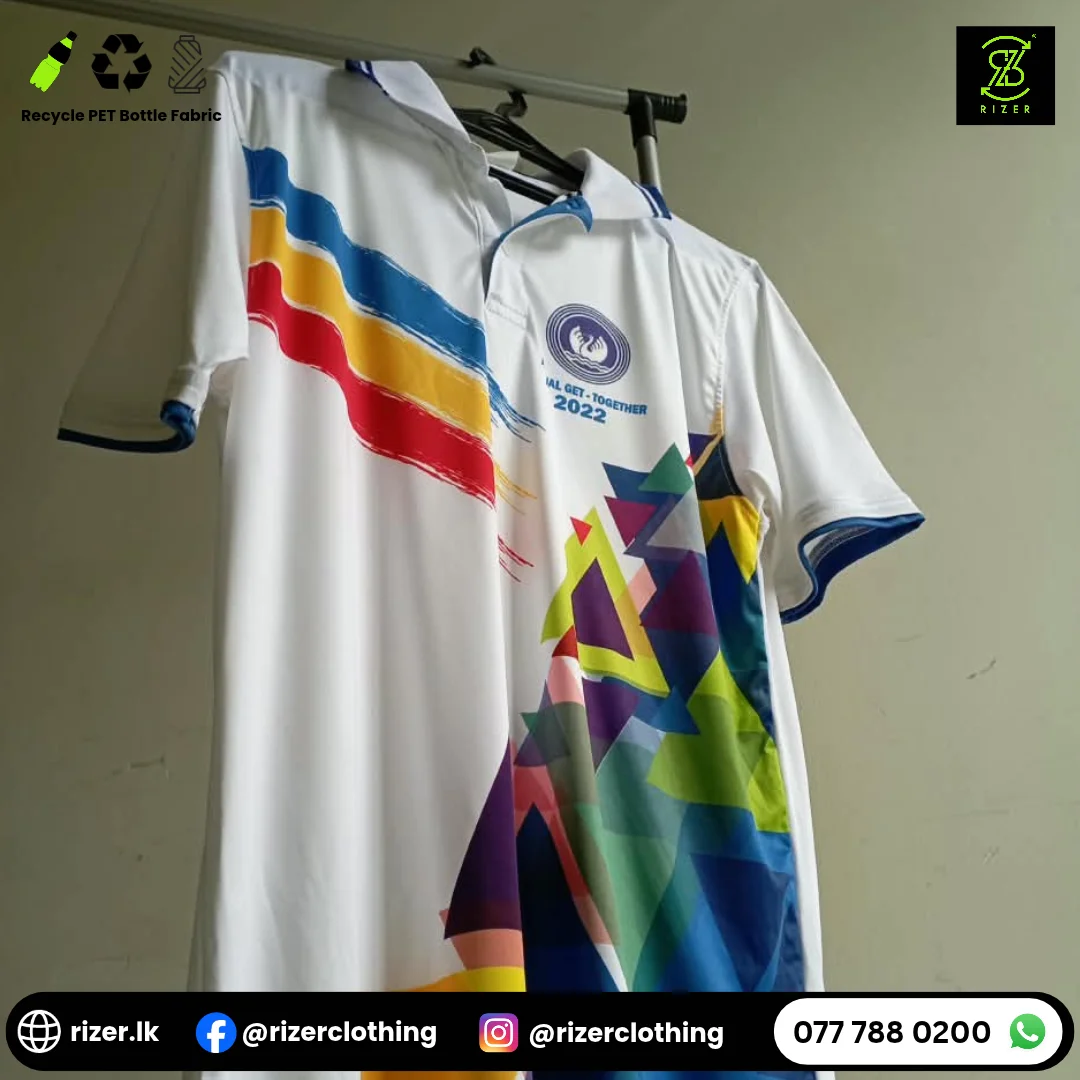
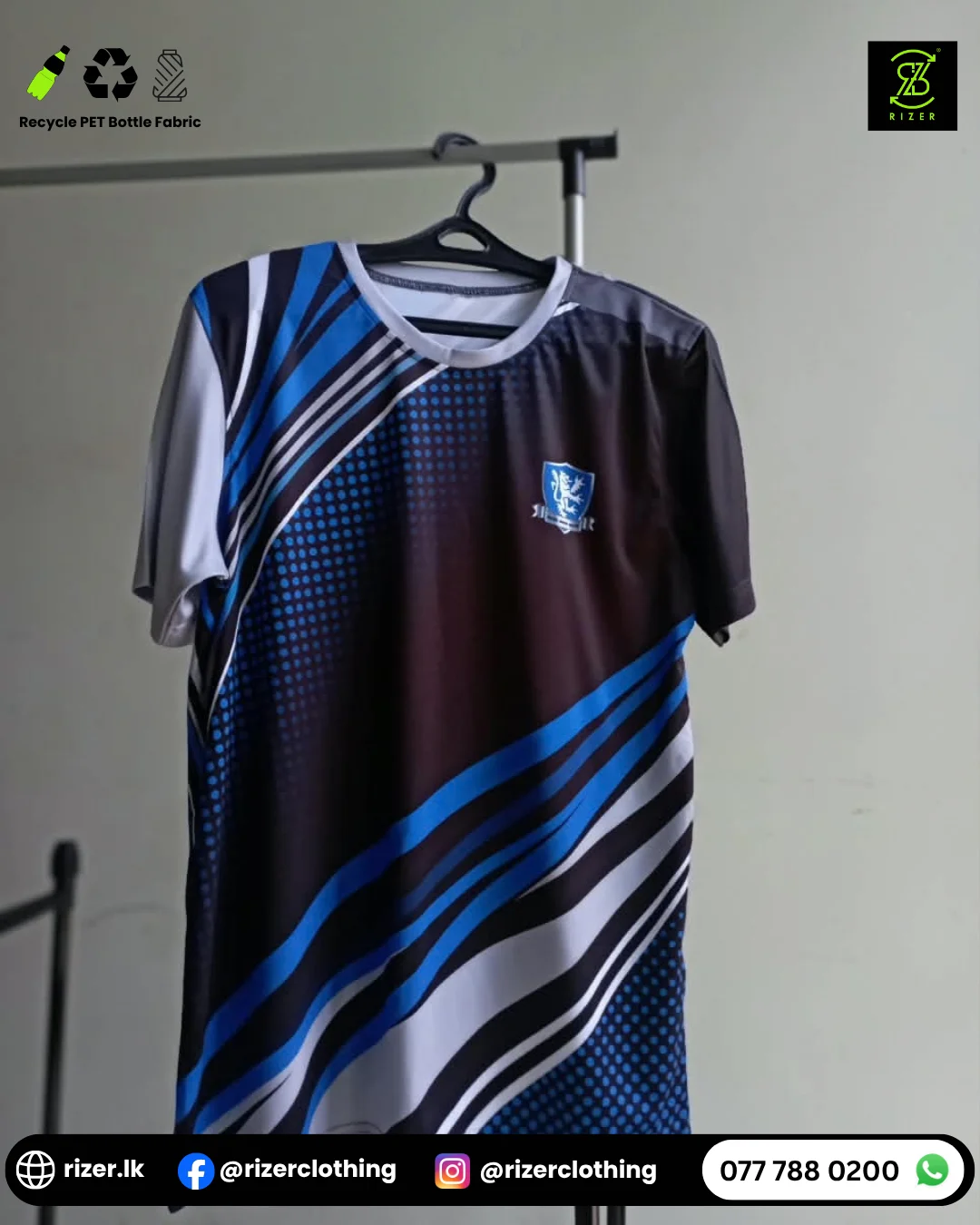
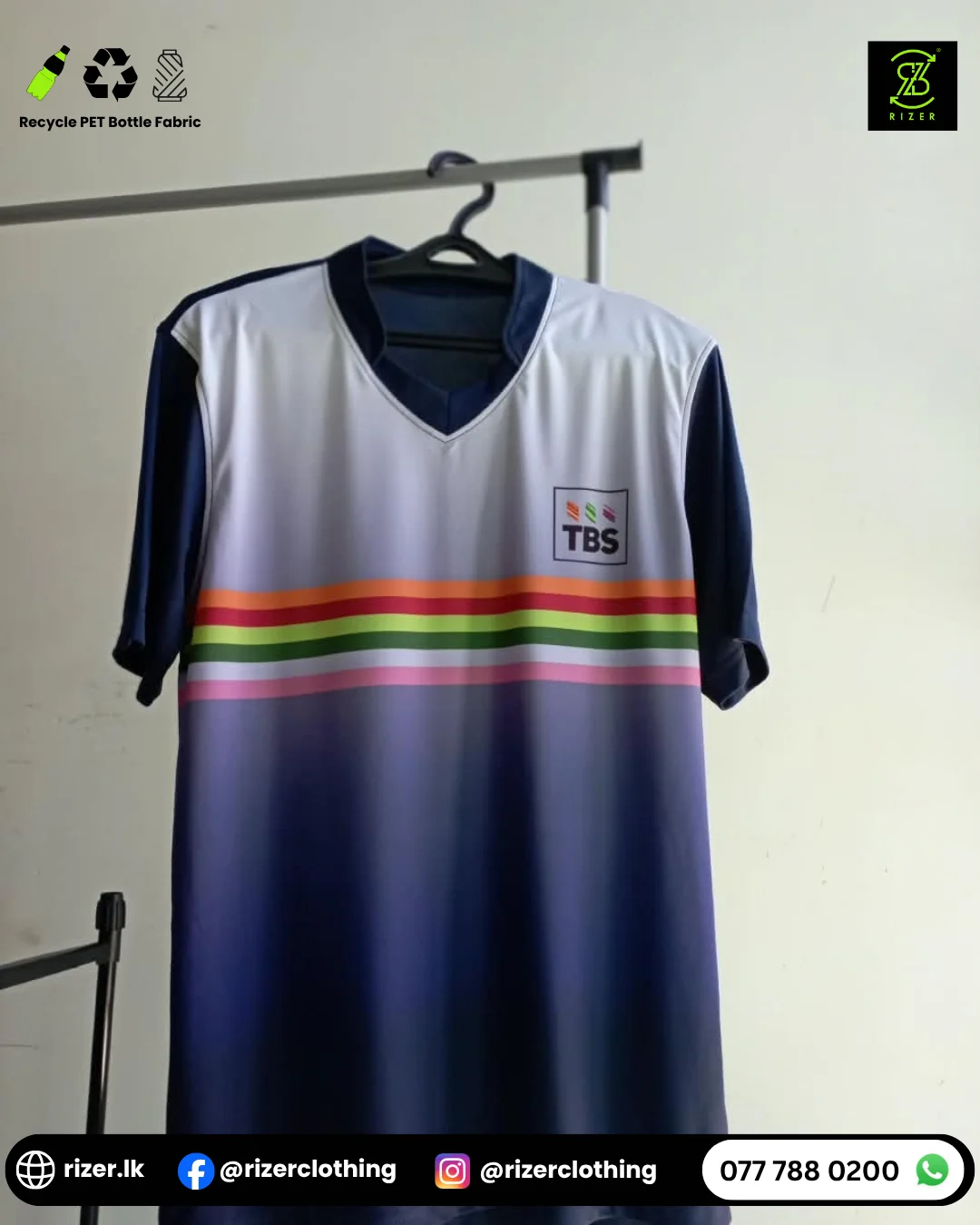
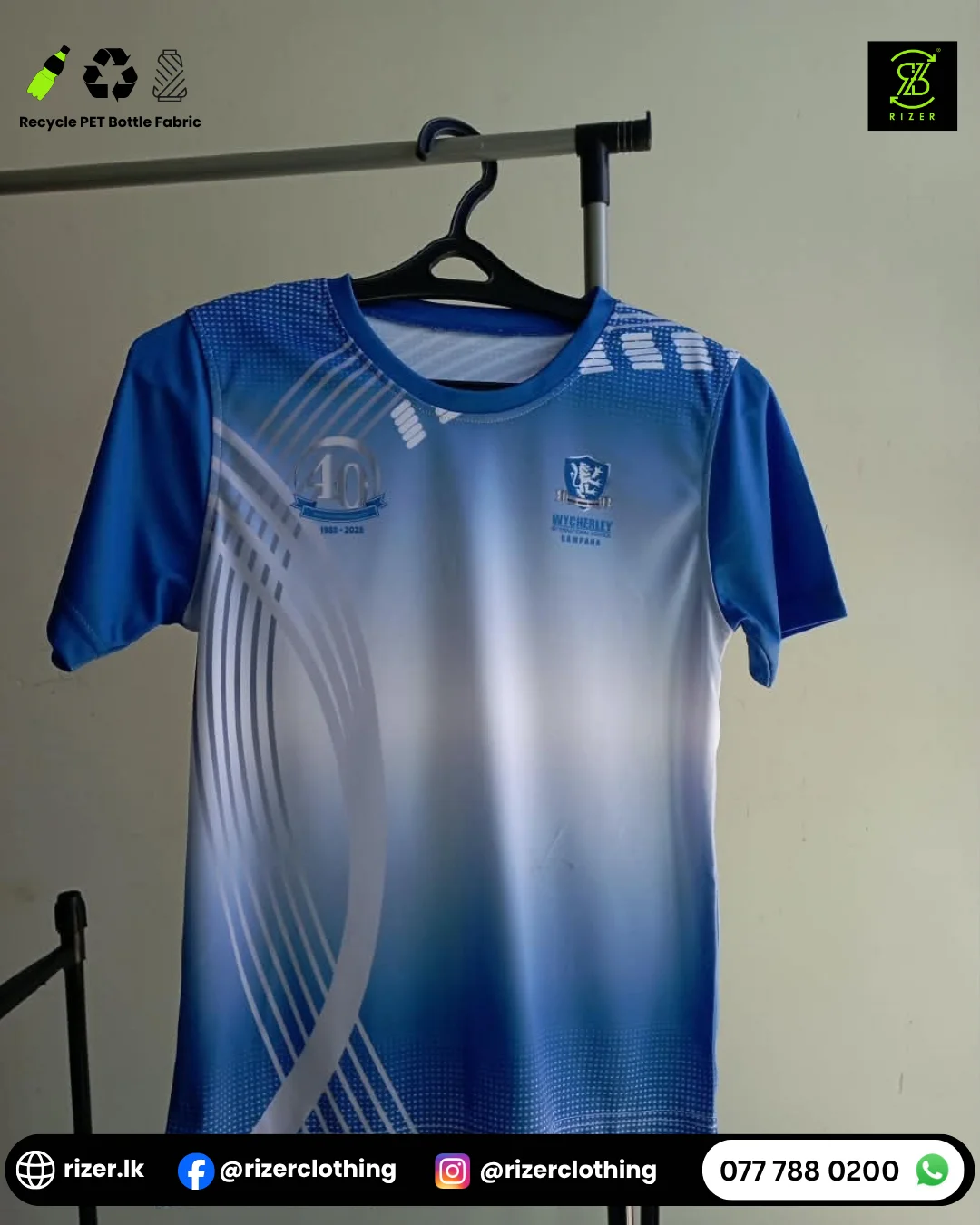
- **Nilwala College (P55):** a white polo with colourful geometric and brush-stroke artwork. The product record lists 100% polyester and 160 GSM. [View Nilwala College polo →](/product/P55/nilwala-college-sublimation-polo-t-shirt)
- **Wycherley Gampaha Western Band (P47):** a crew-neck team jersey with diagonal graphics and chest crests. Its record lists 100% recycled polyester and 140 GSM. [View Wycherley band jersey →](/product/P47/wycherley-gampaha-western-band-jersey)
- **TBS International (P45):** a V-neck event shirt with a gradient and colour bands. Its record lists 100% recycled polyester and 140 GSM. [View TBS International shirt →](/product/P45/event-t-shirt-tbs-international)
- **WISG badminton (P44):** a crew-neck sports jersey with gradient artwork and school badges. Its record lists 100% recycled polyester and 140 GSM. [View WISG badminton jersey →](/product/P44/school-badminton-jersey-wisg)
**Design lesson:** Sublimation can make the garment and artwork feel like one coordinated design. Plan the garment colour and full layout before production, and confirm the fibre composition for the exact order.
What is heat-transfer T-shirt printing, and what is it useful for?
**Short answer:** Heat transfer applies a printed design to a garment with heat and pressure. It is a useful option to discuss for placed artwork such as event marks, names, numbers, sponsor logos and company branding. The exact transfer material and its compatibility depend on the garment and artwork.
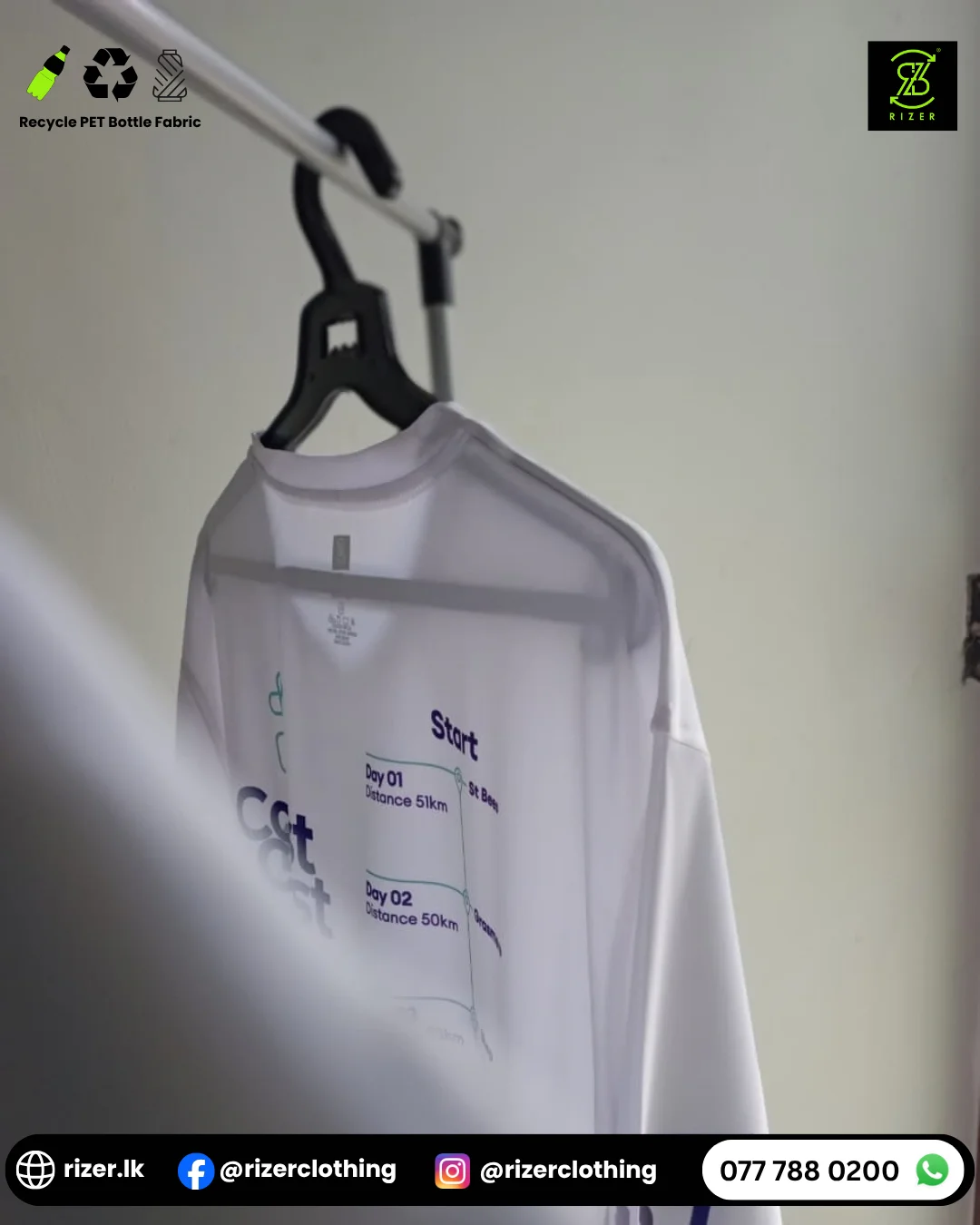
The Coast to Coast 2026 product record lists heat transfer on a white crew-neck shirt made from 100% recycled polyester at 120 GSM. Its project images show event branding alongside a more detailed route and sponsor layout. This is a useful design example when one order needs several pieces of information arranged across front, back and sleeves. [View Coast to Coast 2026 T-shirt →](/product/P38/event-t-shirt-coast-to-coast-2026)
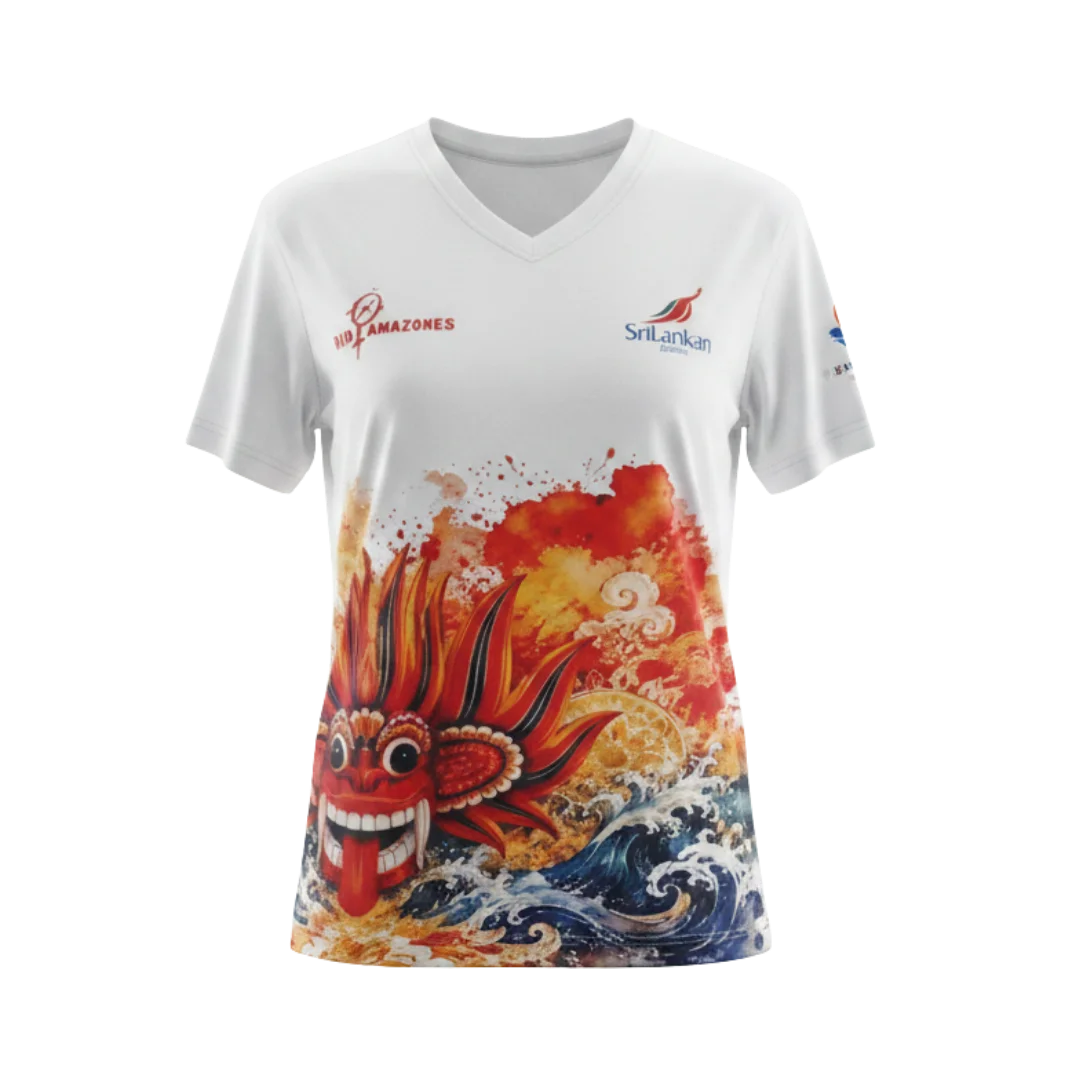
The Raid Amazones product record also lists heat transfer, on a 100% recycled polyester garment at 120 GSM. Its catalog image combines partner marks with a large illustration. That is a different layout from Coast to Coast: one uses a route and sponsor information, while the other gives most of the front to one large graphic. [View Raid Amazones event T-shirt →](/product/P42/event-t-shirt-raid-amazones)
Other product records list heat transfer for a Codimite corporate polo (P41), a RIZER corporate polo (P40), a corporate crew neck (P39) and a RIZER crew neck (P31). This illustrates that a transfer method is not only for full-front designs; it can also be used for smaller branding. Review the [Codimite polo](/product/P41/corporate-polo-codimite) and [corporate crew neck](/product/P39/corporate-crew-neck-t-shirt) examples.
What is DTF printing, and how is it different from sublimation?
**Short answer:** DTF means direct-to-film. The artwork is printed onto a transfer film, then transferred onto a garment with heat. Unlike sublimation, DTF does not rely on dye bonding into polyester fibres, so it can be considered for a wider range of garment colours and fabrics—but compatibility still depends on the specific transfer and garment.
The [Custom T-shirt (P1)](/product/P1/custom-t-shirt) product record lists DTF, a 65% cotton / 35% polyester fabric and 120 GSM. Its catalog image shows a colourful front illustration on a red crew neck. Treat this image as a product example, not as a guarantee that every artwork or fabric will use the same transfer.
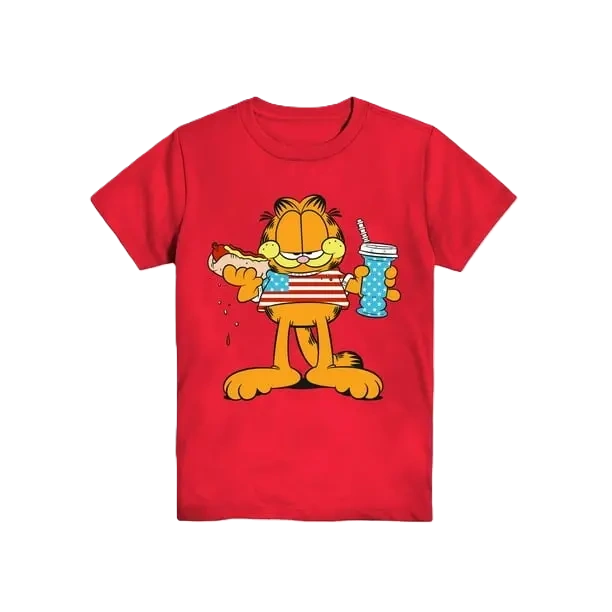
In plain language, DTF can be useful when a detailed, colourful image needs to be transferred onto a chosen garment. Ask about the transfer's feel, stretch, size, wash care and fabric suitability; these details depend on the production materials and garment.
When should you choose embroidery instead of a printed logo?
**Short answer:** Embroidery stitches thread into the garment. It is commonly considered for compact chest logos, crests and wordmarks on polos or uniforms when a stitched appearance is preferred. Very small lettering, fine detail or a dense design may need simplifying.
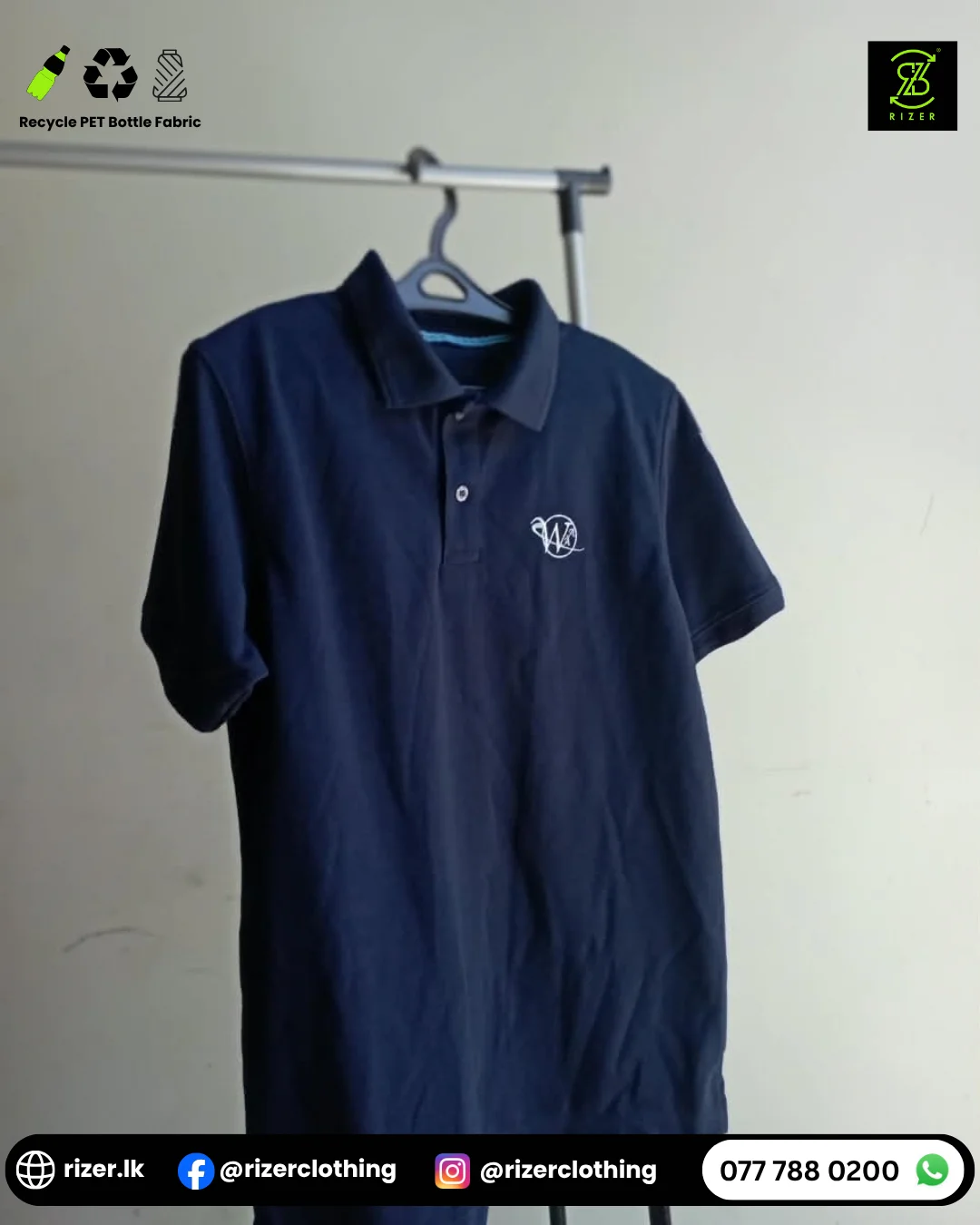
The W.A. Auto Supply polo product record lists embroidery on a 100% recycled polyester garment at 200 GSM. The product images show a small chest crest and a separate company name on the back—an example of keeping a main mark and longer text in different locations. [View W.A. Auto Supply polo →](/product/P46/wa-auto-supply-corporate-polo-t-shirt)
The Coca-Cola corporate polo record also lists embroidery on a 100% recycled polyester garment at 200 GSM. Its images show how branding can be positioned on a dark polo with contrasting trim. [View Coca-Cola corporate polo →](/product/P49/coca-cola-corporate-polo-t-shirt)
The product record, not the look of the photo, is the basis for identifying these as embroidery examples. Ask for a stitch-ready review if your logo contains tiny lettering, gradients or fine lines.
What is Hi-build printing, and what does it look like?
**Short answer:** Hi-build is a raised logo finish. Compared with a flat printed mark, it adds a noticeable dimension that can suit a bold, simple wordmark. The product record identifies the method, while a photograph may show placement but cannot confirm the finished texture.
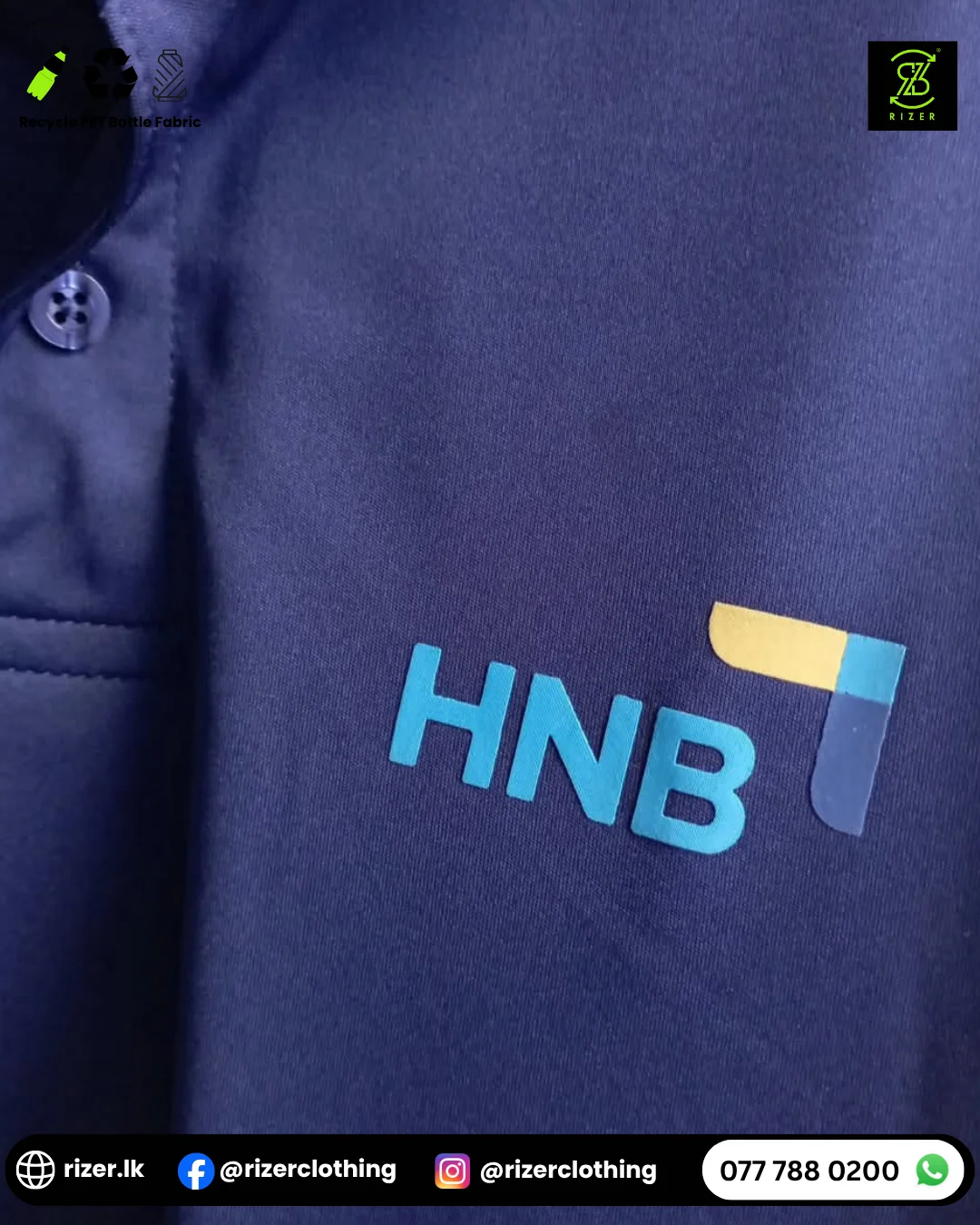
The HNB corporate polo record lists Hi-build on a navy 100% recycled polyester garment at 200 GSM. The product gallery includes this close-up of its chest mark. [View HNB corporate polo →](/product/P48/hnb-corporate-polo-t-shirt)
The Women's Crew Neck T-shirt (P50) product record also lists Hi-build. That record lists 100% recycled polyester at 160 GSM; the product image can help with colour and placement ideas, but confirm the selected logo size and raised finish on a mock-up. [View Women's Crew Neck T-shirt →](/product/P50/women-crew-neck-t-shirt)
Fine lines and very small text may be harder to read when a mark is raised. Ask RIZER to check whether the artwork should be simplified and request a sample or approved mock-up when the surface feel matters.
How do the printing methods compare?
**Short answer:** Start with the artwork and garment. Choose sublimation for polyester-based all-over colour, consider heat transfer or DTF for placed artwork, and compare embroidery or Hi-build when the logo finish is more important than a flat print.
| Method | Good starting point | Fabric or artwork consideration | RIZER product record example | |---|---|---|---| | Sublimation | Gradients, multiple colours and broad coverage | Needs suitable polyester fabric; ask about light-colour base | Nilwala College P55 | | Heat transfer | Placed logos, event graphics, text and sponsors | Confirm transfer type, colour and fabric compatibility | Coast to Coast P38 | | DTF | Detailed or multicolour placed artwork | Check transfer feel, stretch and care for the chosen fabric | Custom T-shirt P1 | | Embroidery | Compact chest logos, crests and wordmarks | Simplify tiny detail; review stitching on the selected garment | W.A. Auto Supply P46 | | Hi-build | Bold logos where a raised effect is wanted | Approve the texture and ensure lettering remains legible | HNB corporate polo P48 |
These are practical starting points, not a promise that every method is available on every RIZER product. Product records can also change, so verify the current specification and request a recommendation for the specific artwork.
What should you check before approving printed T-shirts?
**Short answer:** Confirm the garment, fabric, method, artwork, colour, position, quantity and care details together. Approve a mock-up that shows the design at its intended size on the selected garment.
1. **Select the garment and fabric.** Confirm style, colour, fibre composition and GSM on the product record. 2. **Prepare the artwork.** Send vector artwork where possible, or a high-resolution image; include exact text, names, numbers and brand colours. 3. **State placement and size.** Specify left chest, full front, back, sleeve or other location, with the desired width and height. 4. **Ask for a method recommendation.** Share the artwork and garment together so the printer can review detail, colour, stretch and material compatibility. 5. **Approve the mock-up or sample.** Check the artwork size, spelling, contrast, location and finish; ask about a physical sample if texture matters. 6. **Confirm care and delivery.** Follow the garment's care label and ask about production timing for your quantity and required date.
Textile colour fastness to laundering is tested under defined procedures such as [BS EN ISO 105-C06](https://knowledge.bsigroup.com/products/textiles-tests-for-colour-fastness-colour-fastness-to-domestic-and-commercial-laundering). A home wash is not a substitute for a controlled laboratory test, but you can ask the supplier for care instructions or how a sample should be evaluated.
For a broader logo-placement discussion, read the [RIZER T-shirt logo printing methods guide](/blog/t-shirt-logo-printing-methods-guide-sri-lanka). For garment shape and neckline choices, see [T-shirt designing](/blog/t-shirt-designing) and [custom polo design options](/blog/custom-polo-tshirt-design-options-sri-lanka).
FAQ
Which T-shirt printing method is best? There is no single best method for every order. Sublimation is a starting point for colourful, broad designs on polyester; heat transfer or DTF can suit placed graphics; embroidery suits stitched logos; and Hi-build provides a raised effect. Confirm suitability for your chosen garment and artwork.
Can sublimation printing be used on cotton T-shirts? Standard dye sublimation is intended for polyester or suitable polyester-rich fabric, not 100% cotton. If you want cotton, ask RIZER to recommend another method that fits the garment and artwork.
What is the difference between DTF and heat transfer? Heat transfer describes applying artwork to fabric with heat and pressure. DTF is a specific transfer process where the design is printed onto film and then transferred to the garment. Ask the supplier which transfer process and materials are included in the quote.
Does embroidery count as T-shirt printing? No. Embroidery decorates a garment by stitching thread into it rather than printing ink or dye. It is included in this guide because RIZER product records list it as a logo or decoration method.
What is Hi-build printing? Hi-build describes a raised, dimensional logo finish. Check its actual height, texture and level of detail on a sample or approved mock-up because a product photo cannot show how it feels.
Can one T-shirt order combine printing and embroidery? It may be possible, depending on the garment, artwork and production plan. Tell RIZER which elements should be printed and which should be stitched, then confirm the combination before approving a quotation.
What artwork file should I send for a printing quote? Send a vector file such as AI, EPS, SVG or PDF when available. A high-resolution PNG can also help. Include exact wording, colours, intended garment, quantity and logo placement.
How do I get a quote for custom T-shirt printing in Sri Lanka? Send RIZER your garment or product link, artwork, method preference (if known), quantity, size breakdown and required delivery date. If you are unsure about the method, ask for a recommendation with the quote.
> **Ready to print your design?** [Send your artwork and order details to RIZER on WhatsApp →](https://wa.me/94777880200?text=Hi%20RIZER%2C%20I%20need%20a%20custom%20T-shirt%20printing%20quote.%20Product%3A%20__%20Quantity%3A%20__%20Sizes%3A%20__%20Artwork%3A%20__%20Delivery%20date%3A%20__) or browse [custom T-shirts](/Products?category=T-Shirt).
Sources
- [Custom Ink, What Is Sublimation Printing for Activewear?](https://www.customink.com/blog/what-is-sublimation-printing-for-activewear/)
- [BSI, BS EN ISO 105-C06:2010, Colour Fastness to Domestic and Commercial Laundering](https://knowledge.bsigroup.com/products/textiles-tests-for-colour-fastness-colour-fastness-to-domestic-and-commercial-laundering)
- RIZER product records P1, P31, P38, P39, P40, P41, P42, P44, P45, P46, P47, P48, P49, P50 and P55, and their associated catalog or project images.
Frequently Asked Questions
What is the main takeaway from this t-shirt printing guide?
Compare sublimation, heat transfer, DTF, embroidery and Hi-build with RIZER product examples. Learn how each works, which fabric suits it, and what to approve.
Who should use this t-shirt printing guide?
This guide is for Sri Lankan businesses, schools, universities, event organisers, teams, fashion brands, and organisations comparing custom apparel or fabric options.
How can RIZER help with this t-shirt printing topic?
RIZER can help compare the garment, fabric, GSM, colour, branding method, quantity, sizing, and delivery requirements before preparing a custom quotation.
Sources and methodology
This guide combines RIZER's practical custom-apparel experience with current material and textile guidance. Review the Textile Exchange resource hub and confirm the final specification with a sample or quotation.
Related RIZER Guides
- Custom t-shirt Sri Lanka: Colombo & Panadura Supplier
- Corporate T-Shirt Designing
- Event T-Shirt Designing
- T-Shirt Designing
- Bulk Company T-Shirts Sri Lanka: Order Checklist + Quote
- Custom T-Shirt Price Sri Lanka: What Affects Your Quote
- Custom Polo Shirt Options: Collars, Plackets & Tipping
- Custom T-Shirt Printing Sri Lanka: Methods & How to Order
- Corporate Uniforms Sri Lanka: Supplier Checklist
- Recycled PET Clothing Sri Lanka: Bottle to T-Shirt
- Custom Sports Jerseys Sri Lanka: Design, Sizes & Quote
- Corporate Polo Shirts Sri Lanka: Fabric, Logo & Bulk Tips
- Bulk Apparel Supplier Sri Lanka: Compare & Order Guide
- School & University Event T-Shirts Sri Lanka: Batch Guide
- Beachwear Uniforms Sri Lanka: Hotels, Resorts & Surf Schools
- Wetlook Material Sri Lanka: GSM, Colours & How to Order
- T-Shirt GSM Chart & Meaning: Pick the Right Thickness
- T-Shirt Logo Printing: Heat Transfer vs Embroidery
- T-Shirt Fabric Guide: Cotton vs Polyester vs Blends